How different headaches feel in real life
The first clue is often how your day feels before you even label it a “headache.” Maybe your forehead starts to feel tight while you’re answering emails, or there’s a dull pressure at the base of your skull that shows up halfway through a long meeting. Sometimes it’s not dramatic pain at first—more like your eyes don’t want to focus, your jaw feels busy from clenching, or the room seems a little too bright for no good reason.
The headaches don’t always repeat the same way. A pattern can drift when sleep gets chopped up, caffeine timing changes, or you spend a week hunched over a laptop. Relief habits can blur things too: if you take pain medicine early and often, it may seem like the headache is “lasting longer,” when it’s really becoming harder to tell where the original trigger ends and the bounce-back discomfort begins. Paying attention to timing, location, and what else tags along (nausea, light sensitivity, congestion, neck tightness) can make the next episode less of a mystery.
Tension headaches and the build-up effect

Halfway through the afternoon, you might notice you’re holding your shoulders up toward your ears without meaning to. The discomfort can start as a tight band across the forehead, a heavy pressure behind the eyes, or a sore, grippy feeling in the neck and scalp—more annoying than alarming. What trips people up is how “ordinary” it seems: you can still work, so you keep going, and the headache quietly gathers momentum as the day stacks up.
Tension-type headaches often act like a slow build rather than a sudden hit. Screen glare, squinting, skipped water, jaw clenching, and a forward-leaning posture can each add a small load, and any one fix may only help a little. It may also feel inconsistent—fine on weekends, then back by Tuesday—because the trigger is the rhythm: meetings, deadlines, and sleep that’s just slightly short. Noticing whether the pain stays fairly even on both sides, and whether movement doesn’t drastically worsen it, can help separate “build-up” pain from other patterns.
Migraine patterns beyond “bad headache”
You’re walking into a bright grocery store and suddenly the overhead lights feel sharp, like they have edges. Or you realize you’ve reread the same paragraph five times because your brain won’t “lock on.” For some people, that’s the part that’s easiest to miss: a migraine episode may arrive as a shift in senses or mood before the head pain fully declares itself—yawning, neck stiffness, food cravings, irritability, or a washed-out, foggy feeling that doesn’t match how the day should be going.
When the pain shows up, it often behaves differently than a slow tension build. It may lean to one side, pulse or throb, and make routine movement (stairs, bending down, even turning your head) feel like it turns the volume up. Nausea, light or sound sensitivity, and needing to lie down are common “tag-alongs.” The frustrating part is inconsistency: one week it’s intense; another it’s mostly dizziness and sensitivity. That variability is why people sometimes chase triggers and miss the bigger pattern—sleep debt plus stress plus missed meals—and why repeated “just in case” painkiller use can start blurring where one episode ends and the next begins.
Sinus and allergy pain that mimics headache
You blow your nose, your ears feel a little blocked, and for a moment it seems obvious: this must be a sinus headache. The pressure is right behind the cheeks or between the eyebrows, and leaning forward or moving your head can make it feel heavier. But the “sinus-y” facial pressure can show up with plain nasal irritation from allergies, dry air, or a recent cold—without the deeper, infected feeling people imagine.
When it’s more of an allergy pattern, the discomfort may track with exposure and routine: worse after being outside, after cleaning, or on windy days, with itchy eyes, sneezing, a scratchy throat, or clear drainage. True sinus infection pain tends to feel more one-sided and stubborn, and the congestion is usually thicker, with a sense of being unwell rather than just clogged. Still, overlap happens, and migraine can borrow sinus symptoms too—so the “location” alone doesn’t always settle it.
Cluster headaches and other less common signals
It can start in a way that feels almost unfairly specific: a hot, drilling pain behind one eye that makes it hard to sit still. People often describe pacing, rocking, or feeling “revved up,” not because they’re anxious, but because being still doesn’t match the intensity. One eye may water, the eyelid can droop or swell, and that side of the nose may run or feel stuffed—signs that can be mistaken for allergies until you notice how tightly they stay on one side. The timing can be the giveaway: episodes that hit fast, peak quickly, and return in clusters around the same time each day for weeks.
Less common patterns can be quieter but still distinctive. A sudden, severe “peak in seconds” headache, a new headache after 50, pain paired with weakness, confusion, fainting, fever, stiff neck, or vision changes, or a headache that steadily escalates over days may be worth treating as more than “another bad one.” Even when nothing dramatic is happening, a clear change in your usual pattern is often the detail that matters.
Treatment options: what tends to help, and when
You take something “before it gets bad,” and an hour later you’re not sure if you’re better or just functioning on a thinner layer of patience. That’s a common problem with treatment: the same option can feel like a clean fix one day and a partial, messy one the next, depending on whether the pain is already ramping, whether you’ve eaten, and whether the trigger is still active (glare, clenched jaw, dehydration, missed sleep).
For slower, build-up tension-type patterns, simple steps sometimes matter as much as medicine: loosening the neck and jaw, changing your screen setup, dimming harsh light, drinking water, and eating something can take the “pressure” down a notch. Migraine-leaning episodes often respond best when you act early—before the pain peaks and before nausea makes pills hard to keep down—and the most reliable help may be a mix of rest in a darker room, fluids, and the right medication plan. Sinus/allergy-flavored pressure may ease more with treating the nose and irritation than with repeated painkillers. Waiting too long can make almost any option feel like it “did nothing,” even when it was the right tool.
When a reasonable fix creates new headache problems
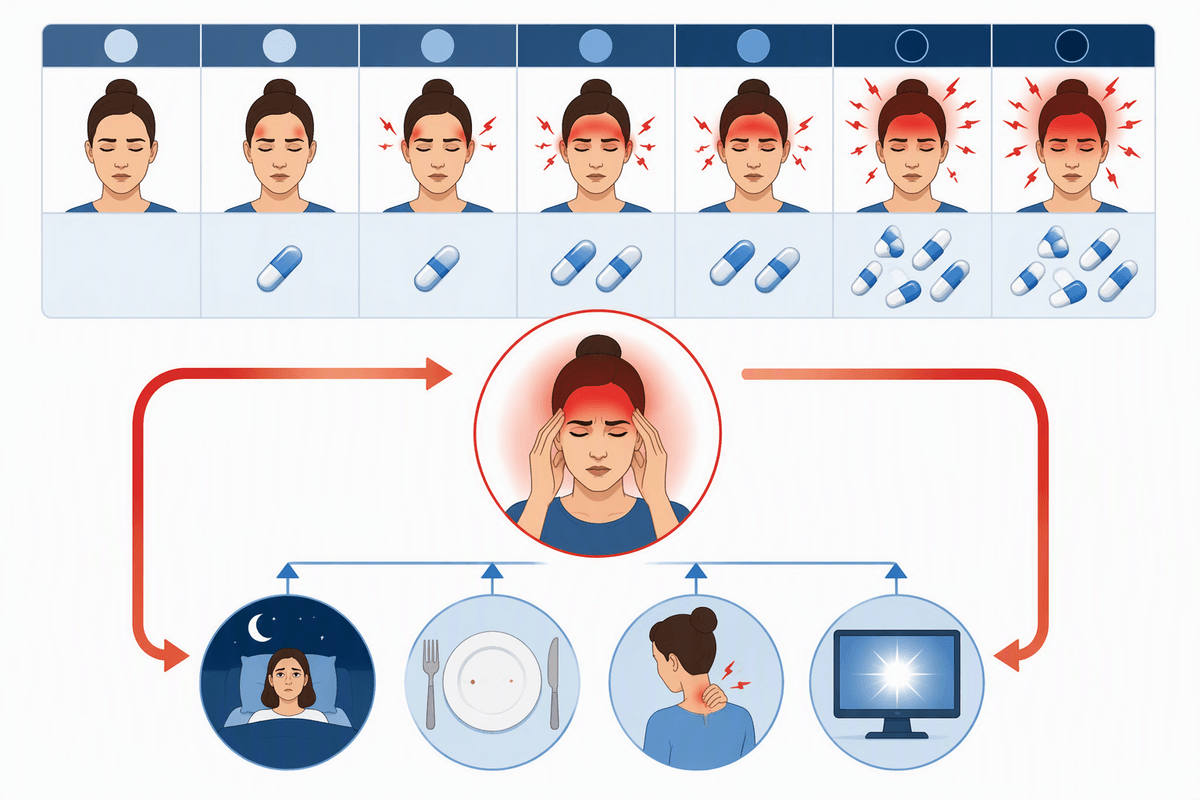
It often starts with a small, reasonable decision: take something so you can get through the afternoon, then take another the next morning “just in case.” For a while it feels like you’re staying ahead of the pain. Then the headaches begin arriving earlier, hanging around longer, or showing up on the days you didn’t expect them. People sometimes describe it as their usual headache getting “stubborn,” but the pattern can be more of a bounce-back—relief for a few hours, followed by a dull return that nudges you toward another dose.
This is one of the easiest loops to misread, because it doesn’t feel like overdoing anything in the moment. Frequent use of common pain relievers (including combination products with caffeine) can gradually train your week into more headache days, not fewer—especially if the original triggers are still stacked underneath: short sleep, skipped meals, neck tension, bright screens. It can look like the headache type is changing, when it may be the schedule that’s changing. If you notice you’re needing medicine more days than not, that detail alone is worth taking seriously.
When to seek care and what to expect
It’s usually the small shift that makes you pause: the headache shows up at a new time of day, it lands in a different spot, or the “normal fixes” barely touch it. Sometimes it’s not even the pain that feels different—it’s what tags along, like unusual dizziness, new sensitivity to light, or a sense that your thinking is slowed down more than you’d expect. When something in the pattern changes and stays changed, it can be worth getting checked, even if you can still power through work.
Certain situations are harder to safely wait out: a sudden, explosive headache that peaks in seconds; headache with weakness, fainting, confusion, seizure, fever, stiff neck, or new vision trouble; a new headache after age 50; a headache after a head injury; or one that steadily worsens over days. If you do seek care, expect questions about timing, location, triggers, sleep, caffeine, and how often you use pain medicine—because sometimes the most useful clue is the calendar, not the single worst day.