Why “fit” doesn’t always mean low cardiac risk
You notice it in the quiet moments: a resting pulse that’s impressively low, then a sudden thump or flutter when you stand up, finish a hard interval, or finally sit down after practice. It’s easy to file those sensations under “athlete stuff,” especially when your splits are improving and your watch keeps rewarding you with better numbers. The misunderstanding is that fitness acts like a shield—if you can train hard, your heart must be fine.
But training changes the heart and the signals you use to judge it. A bigger, more efficient pump can come with slower resting rates, extra beats, or brief irregularity that may feel alarming without being dangerous. At the same time, some patterns don’t care how conditioned you are—family history, certain rhythm tendencies, and how your body handles fatigue, dehydration, stimulants, and missed sleep can matter more than your VO₂ max. What often helps is noticing context: whether symptoms show up at peak effort, right after stopping, or only when recovery is thin.
Athlete’s heart adaptations versus early warning signals
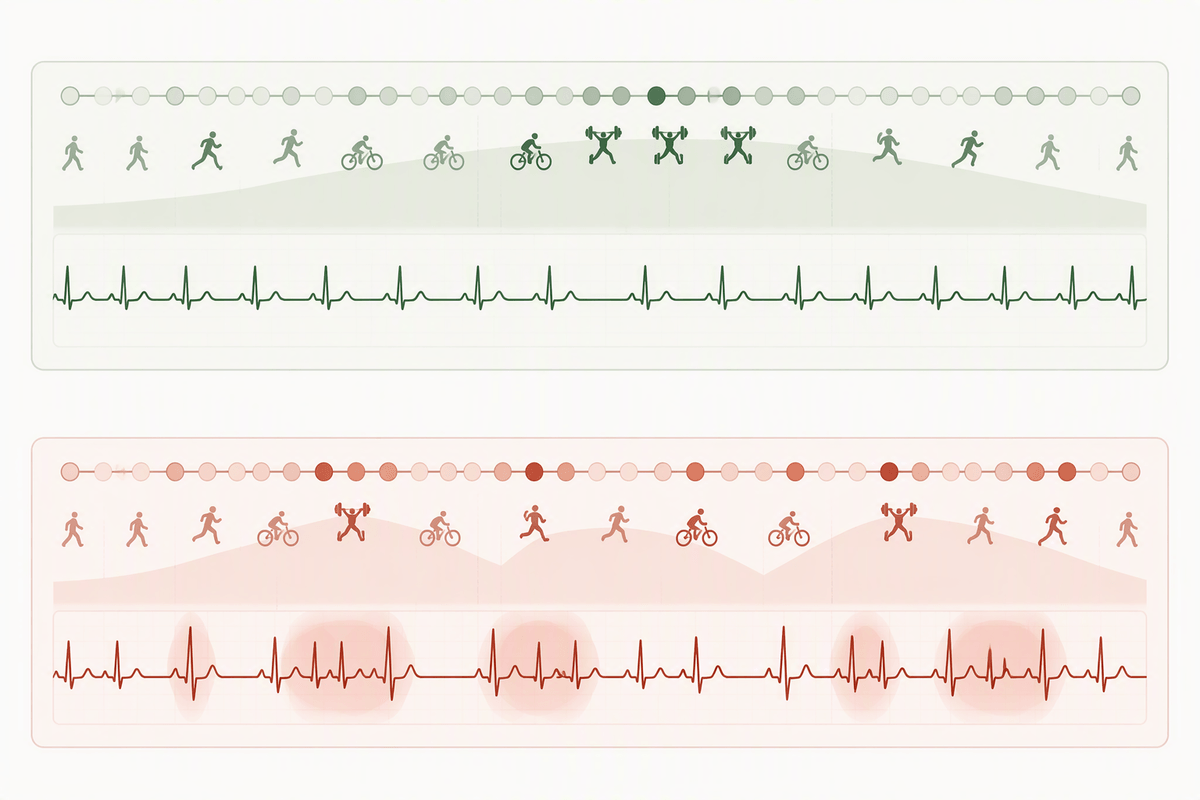
The first time you see it, it may look almost flattering: a heart rate in the 40s, an ECG report that mentions “enlargement,” or a note about a murmur that nobody seemed worried about last year. In trained bodies, those findings can be the “athlete’s heart” version of efficiency—slower resting rhythm, a slightly larger chamber, thicker walls, and stronger stroke volume. The problem is how easily that same language overlaps with early signals of trouble, especially when you’re reading a portal summary without the exercise context.
One difference is how stable the pattern stays as training ebbs and flows. Adaptations tend to track with the season and feel predictable: the low pulse is there on good-sleep weeks and heavy weeks alike. Early warning signals often behave differently—palpitations that cluster when recovery is thin, tightness that shows up only at race-pace surges, breathlessness that’s new for the same power, or symptoms that linger after you stop. None of this is perfectly consistent, which is why small changes over a month can matter more than a single “normal” day.
Symptoms athletes dismiss and why they persist
It’s usually not the dramatic stuff that sticks in your mind. It’s the small, annoying repeat offenders: a “single” skipped beat while tying your shoes, a tight band feeling that fades once you warm up, or that odd breathlessness that shows up after the rep is over—when you’re standing still, bent over, waiting for your heart rate to come down. Because it passes, it gets labeled as nerves, asthma, a bad gel, or just being out of shape for a week, even when training says otherwise.
Those symptoms can persist because they’re tied to patterns athletes live in: sudden stops after maximal effort, dehydration that’s subtle until late, caffeine or pre-workout stacking on top of poor sleep, and a nervous system that swings hard between “go” and “recover.” Sometimes the sensation is strongest in the cooldown, when the heart’s timing is changing quickly. The body isn’t consistent—one perfect night can make everything disappear—so the trend over several sessions ends up being more informative than any single workout.
Training load, recovery debt, and electrical instability
Halfway through a heavy block, it may feel like your heart has “more personality” than usual. The same tempo that felt smooth last month now comes with a few hard thuds in the minutes after you stop, or a brief flutter when you roll over in bed. Because the workout still gets done, it’s tempting to blame nerves or a finicky strap. But training load can change the backdrop your heart is working on: less sleep, lower fueling, mild dehydration, and sore legs that never quite reset can all pile into a kind of recovery debt.
That debt doesn’t always show up as soreness. Sometimes it shows up as timing—your heart’s electrical system reacting to bigger swings between high adrenaline during efforts and a fast drop-off afterward. In some athletes, palpitations cluster in the “in-between” moments: right after sprints, during cooldown, after a hot shower, with extra caffeine, or on travel weeks. A lighter day can make it vanish, which is why patterns across a week often mean more than any single session.
When reasonable performance habits create unexpected discomfort

It can start with something that feels almost too ordinary to count: you take your usual pre-run coffee, squeeze in a workout before work, and realize halfway through the warmup that your chest feels a little “narrow,” like you can’t get the same easy breath. Or the session goes fine until you stop—then there’s a brief run of thumps, a need to cough, or a lightheaded moment that makes you look around to see if anyone noticed. Nothing about the plan was extreme, which is why it’s unsettling.
Reasonable habits can add up in ways that don’t feel dramatic in the moment. Mild dehydration from a hot day, slightly under-fueling, extra salt loss, or stacked stimulants can make your heart rate climb faster and your recovery feel rougher, especially when you go from hard effort to stillness. The same routine may feel normal next week, so it’s easy to dismiss—until the discomfort keeps showing up in the same specific windows.
What sports cardiology evaluates beyond standard checkups
The “normal” result that’s supposed to settle your mind can land oddly: you leave a routine visit with a resting ECG and a quick listen to your chest, yet the thumps still show up after hill sprints, or the tightness only appears when you surge. Standard checkups are snapshots, and a lot of athletic symptoms don’t cooperate with snapshots. They’re tied to transitions—hard effort to sudden stopping, heat to air-conditioning, caffeine to dehydration—so the timing matters as much as the sensation.
Sports cardiology tends to zoom out and then zoom in. Instead of only asking, “Is this test normal?” it asks, “Is it normal for this athlete, in this phase of training, with this family history?” That can mean looking at rhythm over longer windows (including sleep), recreating symptoms with exercise testing that matches your sport, and pairing results with training load, recovery, and fueling patterns. Sometimes the goal isn’t a single yes-or-no answer, but narrowing which situations reliably trigger the problem—and which “normal” findings don’t explain it.
Balancing safety with identity, goals, and uncertainty
The hard part is how quickly a “maybe” becomes personal. You can feel fine on an easy day and still find yourself hesitating before a race, wondering if today’s flutter means something—or if you’re just noticing your body more than usual. Athletes are used to interpreting discomfort as information, but heart sensations don’t always follow the tidy rules of training: they can arrive on recovery days, disappear during the test that was supposed to catch them, or show up only when life stress and sleep loss collide with intensity.
That’s where uncertainty lives: not in a single symptom, but in what it does to your decision-making. Some people push through because stopping feels like losing momentum; others scale back so much they lose confidence. A sports-focused evaluation can help turn “Should I quit?” into narrower questions—what situations reliably trigger it, what changes over a season, and what level of risk you’re actually managing. Even then, the answer may be a plan, not a verdict, and that can be its own kind of relief.