Why walking helps when it’s done consistently
The first week often feels oddly uneven: one day your legs feel lighter, the next your feet complain after the same loop. That swing can be confusing, but it’s also a clue. Walking tends to “work” less like a single workout and more like a repeated signal—small stresses that your body slowly learns to handle. Heart and breathing may adapt faster, while the slower stuff (arches, shins, hips, and tendons) can lag behind, which is why you can feel fitter and still get nagging soreness.
Consistency matters because it smooths out those mismatched timelines. A handful of shorter walks spread across the week often creates more change than one long push followed by several days of feeling beat up. At the same time, always keeping walks tiny and effortless can make everything feel the same week after week. The useful middle is a steady rhythm that leaves you a little challenged but not limping into tomorrow.
Choose a pace that fits your real goal
Halfway down the block, you might notice you’re already “checking your breathing,” but it’s not always clear what that means. Some days a brisk pace feels smooth; other days the same speed makes your shoulders creep up and your stride get choppy. That’s often the first sign you’re walking at a pace you can’t repeat often enough to matter—or one that’s so easy you finish feeling unchanged.
A useful way to sort pace is by what it does to your talk and recovery. If you can speak in full sentences, you’re usually in a steadier zone that’s easier to stack across the week for blood pressure, stiffness, and general fitness. If you can only get out short phrases, that can build conditioning faster, but it also tends to magnify little problems in calves, shins, and feet—especially if you’re new or adding time. The tricky part is that “faster” can feel like progress, right up until tomorrow’s walk becomes the hard one.
Posture and stride tweaks that reduce aches
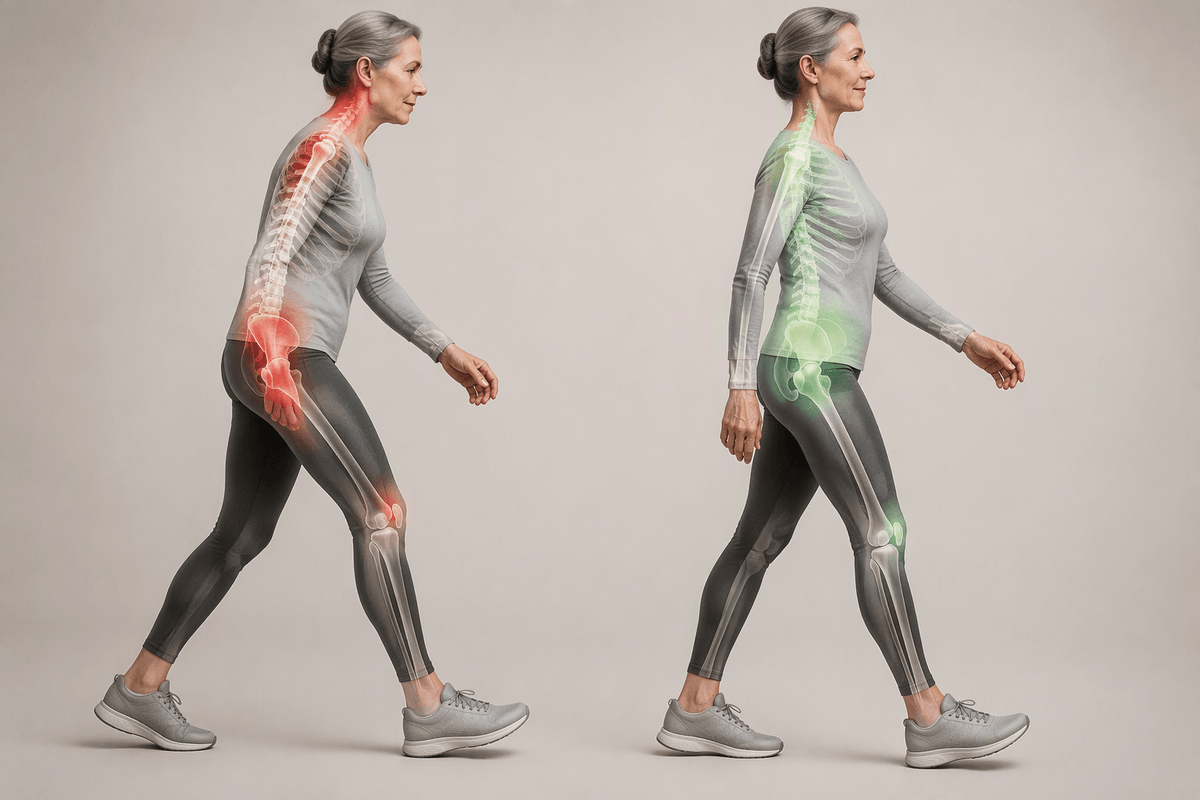
At some point you realize it’s not your legs that are getting tired first—it’s your neck, or the fronts of your hips, or the spot under your kneecap that suddenly “shows up.” Often that isn’t about needing more willpower; it’s the little form changes that sneak in when you speed up: chin drifting forward, shoulders rounding, hands clenching, feet landing a bit too far in front of you. It can feel like you’re walking harder, but the extra strain ends up in joints and tendons instead of your bigger muscles.
A small reset usually looks boring from the outside: tall through the crown of your head, ribs stacked over hips, arms swinging loosely behind you (not across your body). If your steps start sounding heavy, try shortening your stride slightly and aiming for a quieter, more “under you” foot strike—especially on tired days. The catch is inconsistency: the same cue that helps at minute five may fade by minute twenty, which is why aches can seem random until you notice when your posture slips.
Shoes, socks, and surfaces change the whole walk
You notice it when you step off the sidewalk onto rough asphalt: the same pace suddenly feels louder, and the bottoms of your feet start “talking” sooner. It’s easy to blame your conditioning, but footwear and surface quietly change the load with every step. A shoe that feels fine for errands can feel oddly harsh once you repeat it day after day, especially if the midsole is firm or worn down. Socks matter too—thin and slippery can let your foot slide and rub, while thick seams or damp fabric can turn a mild hot spot into a blister that changes your gait without you realizing it.
Surfaces add their own twist. Concrete is predictable but unforgiving; trails and grass are softer but uneven, which can light up calves and ankles in a way that surprises people. Many walkers do best with “boring consistency” for most walks, then small, deliberate swaps—one hillier route, one softer loop—so you can tell whether a new ache is your body adapting or just a change in what your feet are absorbing.
The common mistake: doing too much too soon

The slip usually happens on a “good day.” Your breathing feels easier, you hit the far corner without stopping, and it’s tempting to add another loop just to prove you can. Your lungs and confidence can improve faster than the parts that have to absorb thousands of repeated landings. Feet, shins, hips, and tendons may not complain during the walk; they tend to answer later, when you stand up from the couch and the first few steps feel stiff or oddly sharp.
A common pattern is stacking too many changes at once: longer time, faster pace, hillier route, newer shoes, and a harder surface—then wondering why the “same” walk suddenly feels hostile. The next day becomes the test you didn’t plan for. If you start shortening your stride without meaning to, or you feel like you need to “warm up” for ten minutes before things calm down, that’s often your body asking for a smaller jump than your motivation picked.
Build habits that survive busy and low-motivation days
It usually shows up as a tiny negotiation: you’re dressed, the day is packed, and you catch yourself thinking that if you can’t do the “real” walk, there’s no point starting. That all-or-nothing trap is where routines quietly break. The body tends to respond better to a repeatable signal than to occasional heroic outings, even when the repeatable version is short. On low-energy days, the first five minutes can feel stiff and pointless—right up until you notice your stride smoothing out and your mood shifting a notch.
What holds up in real life is often a simple floor-and-ceiling plan. A “floor” walk is the one you can do when motivation is low: same shoes, familiar route, easy pace, and done before you talk yourself out of it. A “ceiling” walk is what you do when time and legs cooperate. That range keeps you from overreaching on good days and disappearing on hard ones, and it makes it easier to spot patterns—like soreness that follows speed upgrades, not busy weeks.
Know when walking needs a pause or upgrade
Sometimes the clue isn’t during the walk at all—it’s the first minute after you’ve been sitting. If those early steps feel creaky but loosen quickly, that’s often just “normal stiff.” If a spot feels sharp, makes you limp, or changes the way your foot lands, it may be a sign that yesterday’s dose didn’t match your recovery. You can be fine on flat ground, then feel a pinch on stairs, or only notice it when you speed up to catch a light.
In practice, a pause usually isn’t about quitting walking; it’s about keeping the signal while lowering the cost. That might mean shorter, flatter, slower walks for a few days, or a rest day when the same ache keeps showing up at the same minute mark. An “upgrade” tends to make sense when your usual route feels too easy and you’re recovering cleanly—then a small nudge (a few extra minutes, a slightly brisker segment, one hill) is more likely to build fitness without waking up the old niggles.