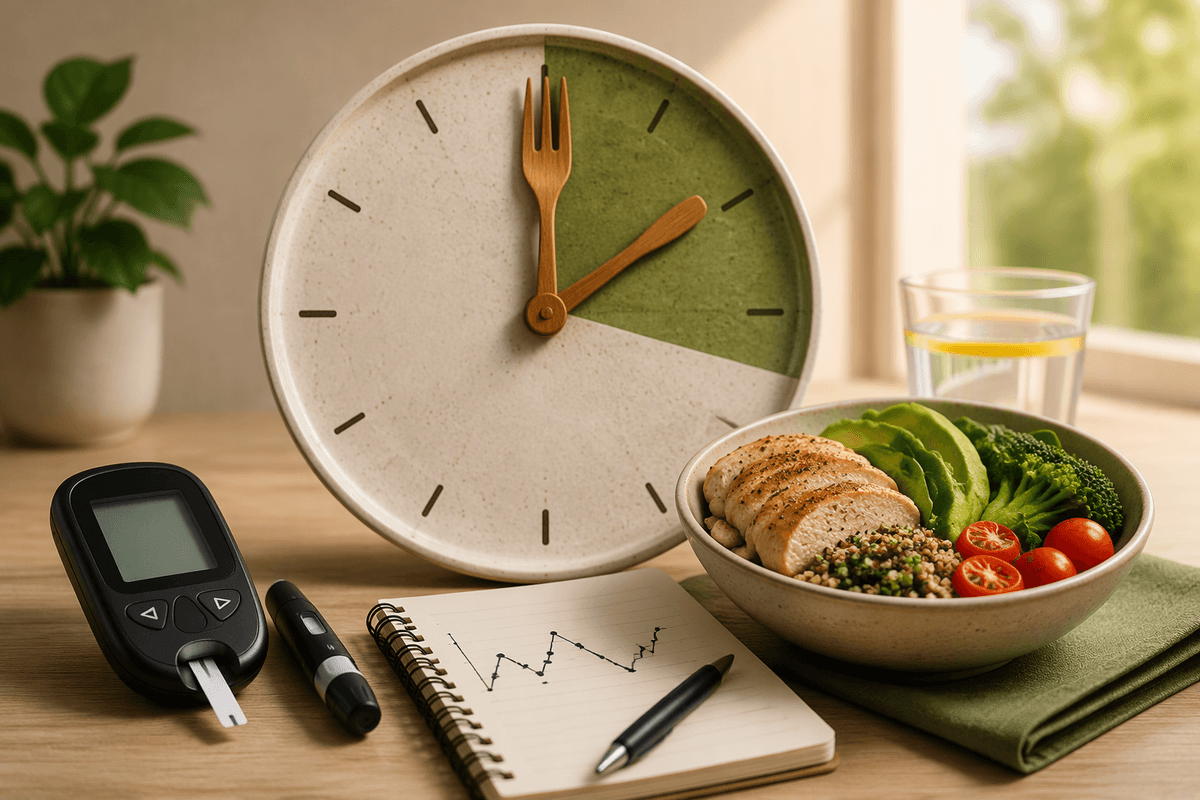
Why fasting can feel simpler than it actually is
The first few days of intermittent fasting can feel oddly clean: fewer decisions, fewer snacks, and a clock that tells you when you’re “allowed” to eat. Then real life shows up. A late meeting pushes your first meal back, you drink coffee a little stronger than usual, and by mid-morning the hunger isn’t just hunger—it’s a slightly shaky, wired feeling that’s hard to label. Some people read that as “fat burning,” while others assume they’re doing it wrong, even though the same schedule can feel different from one week to the next.
What makes it complicated is everything it nudges: sleep (and early-morning glucose), stress hormones, meal size, and the timing of any glucose-lowering meds. You may also eat fewer hours but more aggressively, which can trade fewer eating events for bigger post-meal spikes. If the pattern keeps shifting—weekdays one way, weekends another—your numbers can look inconsistent even when your effort is steady.
What fasting changes in glucose and insulin patterns
The first clue often shows up before you even eat: you wake up and the number is higher than you expected, even though you “did everything right” the night before. That can be frustrating, especially if you’re comparing it to a non-fasting week. In some bodies, a longer gap between dinner and the first meal seems to amplify that early-morning rise, partly because the liver keeps releasing glucose while insulin levels stay lower. But it doesn’t happen the same way every day—short sleep, an earlier workout, or a stressful morning can tilt the trend.
Once you do break the fast, the pattern can flip. A larger first meal, eaten quickly because you’re too hungry, may create a sharper post-meal spike than your usual breakfast did. Some people then “correct” by waiting even longer to eat again, which can set up a rebound appetite later and a heavier dinner. Over a few weeks, the most useful insight is often not a single reading, but whether your usual highs and lows are shifting in a repeatable direction.
The hidden role of medications and hypoglycemia risk

The first time it happens, it can feel like you’re just “a little off.” You stand up from your desk late morning, and the room seems too bright. There’s a thin layer of nausea, maybe a tremor in your hands, and it’s easy to blame coffee or poor sleep. But if you’re taking a medication that keeps working whether you eat or not, that same fasting window can quietly shift from “manageable” to “too long,” even when your glucose has looked fine on other days.
This is where people get surprised: the fasting schedule didn’t change, but your risk did. Some glucose-lowering meds can push numbers down regardless of meal timing, while others mainly act around food. When your first meal slides later, the “gap” between your dose and your carbs gets wider, and the low can show up before you expect it—or later, after a workout or a smaller-than-usual meal. Not everyone feels lows clearly, and the pattern can be inconsistent, which is why logs sometimes look confusing before they look helpful.
When a reasonable fasting plan backfires unexpectedly
A week or two in, the problem isn’t always the fasting window—it’s how it collides with an ordinary day. You skip breakfast as planned, feel fine, then a long drive, a busy shift, or a stressful call stretches the morning. By the time you finally eat, you’re not just hungry; you’re impatient. That first meal gets bigger, faster, and starchier than you intended, and the meter later makes it look like fasting “caused” the spike, even though it may be the rebound pattern that did it.
Other times it backfires in the opposite direction: your numbers look decent, but you’re waking up wired at 3 a.m., or you’re getting headaches and a low-grade fog that makes work harder. People often respond by tightening the window further, when the more relevant clue is inconsistency—weekday fasting, weekend grazing, dinner timing sliding later and later. The plan can still be reasonable on paper, yet your body treats it like a moving target, and the data starts to reflect that.
Choosing an eating window that fits real life

The issue usually shows up in the calendar before it shows up on the meter. A window that looks “perfect” on paper can unravel the first time lunch gets pulled into a meeting or dinner turns into a late family event. Then you’re left choosing between eating earlier than planned (and feeling like you failed) or waiting so long that your first meal becomes a pressure release. Either way, the numbers that follow can be hard to interpret because the real variable wasn’t willpower—it was timing friction.
In practice, the most workable window is often the one that keeps your first meal and your last meal in roughly the same place most days. Earlier windows tend to reduce the late-night “catch-up” eating that drives bigger post-dinner spikes, but they can make mornings feel thin if you’re active or on meds that don’t wait for food. Later windows can feel socially easier, yet they sometimes stack more carbs into the evening, when sleep and morning readings can take the hit. If your logs look noisy, it may be less about the window length and more about how often it shifts.
Building meals that support steadier glucose during IF
The first meal after a long gap can land heavier than you planned. You sit down thinking you’ll “eat normal,” but you’re so ready to be full that the pace speeds up, and the plate quietly turns into two plates. When that happens, the spike you see later can feel like fasting failed, even though it may be the combination of bigger portions, faster eating, and a carb-heavy first bite that did most of the work.
Meals that tend to produce steadier curves often have a “brake” built in: protein and high-fiber foods show up early in the meal, not as an afterthought. It may be as simple as eggs or Greek yogurt before the toast, or a salad and chicken before rice or pasta. The same meal can behave differently depending on sleep, stress, and how long you waited to eat—so the most useful comparison is usually your own repeat meals on similar days, not a one-time “perfect” number.
How to judge results without chasing perfect numbers
The temptation is to treat every reading like a grade. You get one higher morning number and assume the whole fasting plan is off—even if your after-lunch spikes are smaller and your late-night snacking has faded. The meter is sensitive to sleep, stress, and timing drift, so “better” often shows up as a quieter pattern, not a straight line.
In your log, look for repeatable changes: fewer big post-meal jumps, less urgent hunger before the first meal, fewer surprise lows if you’re on meds, and steadier energy through the afternoon. If the data only looks good on perfect days, that’s still information—the routine may be too tight to live in.